A marine travel lift (also known as a mobile boat hoist) represents one of the most significant capital investments a marina, boatyard, or commercial port can make. These heavy-duty machines are the operational hub of any waterfront facility, responsible for safely hoisting, transporting, and launching vessels that often represent millions of dollars in private or commercial value.
Because a quality boat hoist is engineered to last 20 to 30 years or more, choosing the wrong configuration can limit your yard’s operational capacity, compromise safety, or lead to premature structural failures. For first-time buyers, the procurement process involves evaluating a complex array of mechanical, structural, and civil engineering variables.
This technical guide outlines the essential checklist items first-time buyers must evaluate before purchasing a marine travel lift.
1. Determining True Lift Capacity
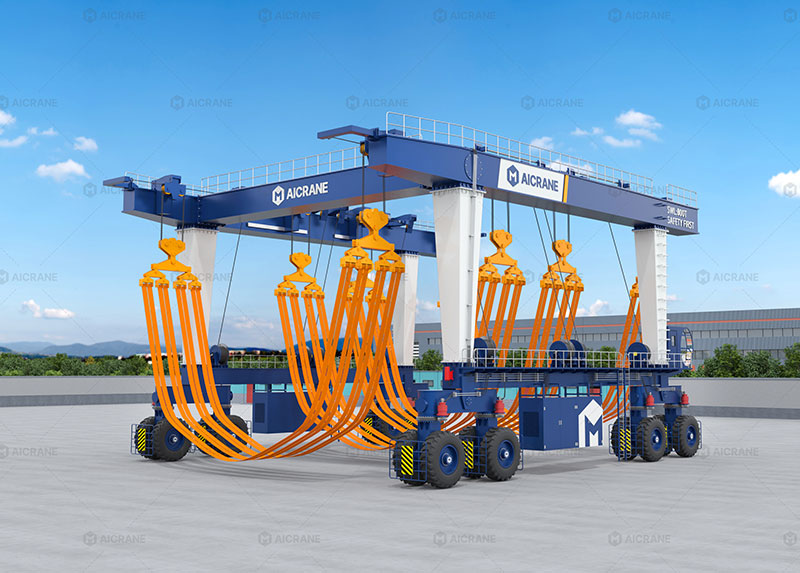
The nominal rating of a travel lift (e.g., 50 ton, 100 ton, or 300 ton travel lifts) refers to its maximum safe working load under ideal conditions. First-time buyers must calculate their target capacity based on actual operational realities rather than theoretical maximums.
- Account for Full Vessel Weight: A vessel’s registered displacement rarely reflects its true hoisting weight. You must account for full fuel tanks, water storage, heavy onboard gear, commercial payloads, and the accumulated weight of marine growth on the hull.
- The 20 Percent Safety Margin: Industry standards recommend purchasing a lift with a capacity that is at least 15 to 20 percent higher than the heaviest vessel you intend to haul. For example, if your target market includes yachts with a maximum weight of 80 tonnes, you should invest in a lift rated for at least 100 tonnes. This buffer protects the hydraulic and structural systems from fatigue.
- Tackle and Slings Weight: Remember that the weight of the spreader bars, heavy-duty wire ropes, and synthetic slings themselves must be factored into the overall load calculations of the machine’s winch systems.
2. Dimensional Compatibility and Vessel Clearance
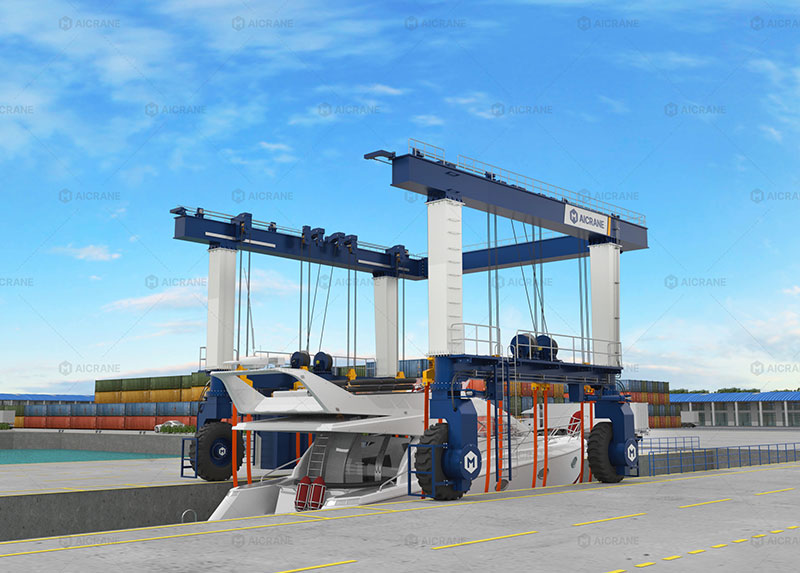
A travel lift must physically match the geometry of both the vessels it handles and the yard’s launching well. The three critical dimensions to calculate are inside clear width, inside clear height, and wheelbase length.
- Inside Clear Width: This determines the maximum beam (width) of the vessels you can lift. If the clearance is too narrow, you will turn away wide-beam catamarans, commercial tugs, or wide-hulled yachts. Conversely, an excessively wide machine may require a wider launching well, dramatically increasing civil construction costs.
- Inside Clear Height: This is the distance from the ground to the lowest structural cross-member (the top beam). The lift must be tall enough to clear the high superstructures, flybridges, and radar masts of powerboats while they are suspended in the air.
- Wheelbase and Overall Length: The length of the machine dictates its stability and how it distributes weight across its tyres. It also influences the turning radius required to navigate the corners of your storage yard.
3. Steering and Mobility Configurations
Modern marine travel lifts offer several steering configurations to maximize yard space. While standard two-wheel steering is the most cost-effective, multi-mode steering provides critical maneuverability in tight storage configurations.
- Standard Two-Wheel Steering: The front or rear wheels steer while the opposite wheels remain fixed. This is suitable for large yards with wide pathways and simple straight-run launching slips.
- All-Wheel Steering (Multi-Mode): This allows the operator to switch between multiple steering programs, such as:
- Coordinated Steering: All wheels turn in opposite directions to minimize the turning radius.
- Crab Steering: All wheels turn 90 degrees parallel to one another, allowing the machine to drive sideways. This is invaluable for packing boats tightly side-by-side in a storage yard.
- Carousel Turn: The wheels turn at tangent angles, allowing the lift to rotate 360 degrees on its own axis.
- Gradeability and Terrain: Evaluate the slopes in your yard. Standard mobile boat hoists are rated for 1 percent to 2 percent grades. If your yard has steeper inclines (such as ramps leading away from the water), you must specify a drive system with higher torque and specialized hydraulic braking to prevent runaway conditions.
4. Sling and Hoisting Systems
The hoisting system is the direct point of contact with the vessel. Its configuration directly impacts both hull safety and operational speed.
- Number of Hoisting Points: Smaller lifts (up to 50 tonnes) typically use two hoist points on each side. Larger units use four or more hoist points. Multiple points distribute the crushing forces more evenly across the vessel’s structural bulkheads.
- Adjustable Sling Positions: Different vessels require different sling spacing to avoid damage to prop shafts, rudders, and keel-mounted instruments. A hydraulic sling adjustment system allows the operator to slide the hoisting points forward or backward along the frame while under load, reducing setup times.
- Sling Material and Protection: Specify flat-woven, high-strength polyester slings. For yachts with sensitive hulls, search for slings equipped with protective sliding pads or lead-weighted chine protectors to prevent the slings from slipping off the hull curve.
5. Control Systems: Cabin vs. Remote Control
First-time buyers must decide how the operator will control the machine. The choice impacts both safety and labor efficiency.
- Radio Remote Control (RRC): This is the modern industry standard. It allows the operator to walk around the machine, observing clearances at all four corners, the sling placement, and the dock edge. RRC minimizes the need for extra spotters, improving safety and lowering operational labor costs.
- Operator’s Cabin: A mounted cabin protects the operator from harsh weather (such as cold, wind, and rain) and is preferred in high-volume industrial shipyards or regions with extreme climates. However, the operator has limited visibility of the blind spots on the opposite side of the machine, requiring constant communication with ground spotters.
6. Civil Engineering and Yard Infrastructure
The purchase of a travel lift cannot be separated from the civil engineering of your site. The machine’s weight, combined with the weight of the boat, creates massive localized wheel loads.
- The Launching Well (Pier Structure): The concrete runways extending over the water must be engineered to support the maximum wheel loads of the fully loaded lift. This requires specialized geotechnical surveys, piling design, and concrete reinforcement.
- Yard Runway Surface: Operating a heavy travel lift on unpaved gravel or soft asphalt will cause rutting, uneven tire wear, and dangerous structural swaying. The primary travel routes must be paved with reinforced concrete or engineered asphalt thick enough to prevent soil subsidence.
- Overhead Clearances: Check for overhead power lines, tree branches, or building eaves along all planned travel paths. A tall travel lift can easily strike low-hanging utilities.
7. Lifecycle Support and Total Cost of Ownership (TCO)
The initial purchase price of marine travel lift is only a portion of its true lifecycle cost. Buyers must evaluate the long-term support network of the manufacturer.
- Corrosion Resistance: Because these machines operate in highly corrosive marine environments, paint and structural treatment are paramount. Look for sandblasted steel frames coated with multi-layer epoxy primers and polyurethane topcoats, along with stainless steel hydraulic fittings and tubing.
- Parts Availability and Maintenance: If your travel lift is down during the peak spring launching season, your marina will lose thousands of dollars in revenue per day. Ensure the manufacturer has a regional parts warehouse and accessible field technicians.
- Compliance and Certification: Verify that the machine is designed and manufactured in accordance with relevant international standards, such as ASME B30.22, OSHA regulations, or CE directives, depending on your geographic region.
Summary Checklist for Buyers
Before signing a procurement contract, ensure you have documented and verified the following engineering and operational parameters:
| Category | Checklist Parameter | Verification Status / Goal |
|---|---|---|
| Capacity | Heaviest vessel weight plus 20 percent safety margin | Checked / Calculated in tonnes |
| Beam Clearance | Inside clear width vs. widest target vessel beam | Minimum 1.5 meters clearance margin |
| Sling System | Hydraulic sling adjustment capability | Required for mixed fleet yards |
| Steering | All-wheel multi-mode steering (crab/carousel) | Required for tight yard configurations |
| Infrastructure | Pier load capacity certification | Must match maximum wheel load specs |
| Controls | Wireless radio remote with backup tether | Highly recommended for safety |
| Warranty & Support | Local technician availability and parts turnaround | Under 24-hour response target |
By carefully analyzing each of these parameters, first-time buyers can ensure they select an Aicrane marine travel lift that optimizes yard efficiency, secures structural safety, and yields a high return on investment over decades of service.