Rapid urban growth across major Latin American metropolitan centers like São Paulo and Bogotá has driven an unprecedented demand for construction materials. To supply high-volume civil infrastructure projects, material processing facilities must operate closer than ever to residential neighborhoods and urban peripheries. Operating an aggregate plant near dense population hubs offers distinct logistical advantages, significantly shortening haulage distances and cutting transport emissions. However, operating within urban boundaries brings severe environmental scrutiny, specifically regarding fugitive dust, particulate matter emissions, and noise pollution. Maintaining community compliance and securing social license to operate now requires modern processing facilities to adopt comprehensive, eco-friendly dust suppression frameworks.
The Challenge of Urban Proximity: Dust and Noise in Metropolitan Operations
Aggregates are the lifeblood of concrete and asphalt production, but the physical reduction of hard rock inherently generates high volumes of airborne dust. In metropolitan hubs like Bogotá, situated in a high-altitude basin where atmospheric inversion traps fine particles, and São Paulo, where strict local environmental agencies like CETESB enforce rigorous PM10 and PM2.5 air quality limits, dust managementof aggregate plants(planta de agregados) is a matter of legal survival. Uncontrolled particulate dispersion leads to immediate municipal fines, operational suspension, and severe friction with neighborhood associations.
Fugitive dust is created at every stage of material handling—from initial dumping of blasted rock into the feed hopper to primary breaking, secondary reduction, screening, and product stockpiling. The primary reduction stage, typically anchored by a heavy-duty jaw crusher, generates coarse and medium airborne particles during high-force compressive fracturing. Without adequate containment, moisture conditioning, and enclosure systems, wind carry can spread these fine rock particles across several square kilometers, impacting nearby residential air quality and overburdening local drainage systems.

Key Technologies for Dust Mitigation in Crushing and Screening Circuits
Modern aggregate production requires integrating effective suppression mechanisms directly into processing equipment. Rather than relying solely on perimeter water sprinklers, progressive mine managers apply targeted dust control solutions at the exact point of material fracture and transfer.
Primary Breaking and Coarse Feed Conditioning
The initial reduction stage experiences severe mechanical stress as large boulders enter the hopper. Utilizing a robust jaw crusher allows operators to handle abrasive basalt, granite, or limestone efficiently. To control dust at this critical entry point, high-pressure misting nozzles should be installed along the feed opening and discharge chute. Micro-droplet atomization binds with fine airborne particles without over-wetting the raw material, preserving processing efficiency while drastically reducing dust plume formation.
Secondary Reduction and Fine Material Shaping
When shaping cubical aggregates for high-grade asphalt and structural concrete, operators rely on secondary and tertiary reduction units. Passing feed material through an impact crusher delivers exceptional particle shape through high-speed kinetic impacts, but this process inherently generates a higher percentage of ultra-fine dust. To prevent fine silica and rock dust from escaping into adjacent communities, impact circuits must be fitted with sealed rubber curtains, negative pressure dust collection hoods, and enclosed return conveyors that route fine particulates into dedicated filter bags or wet scrubbers.
Flexibility and Suppression on On-Site Operations
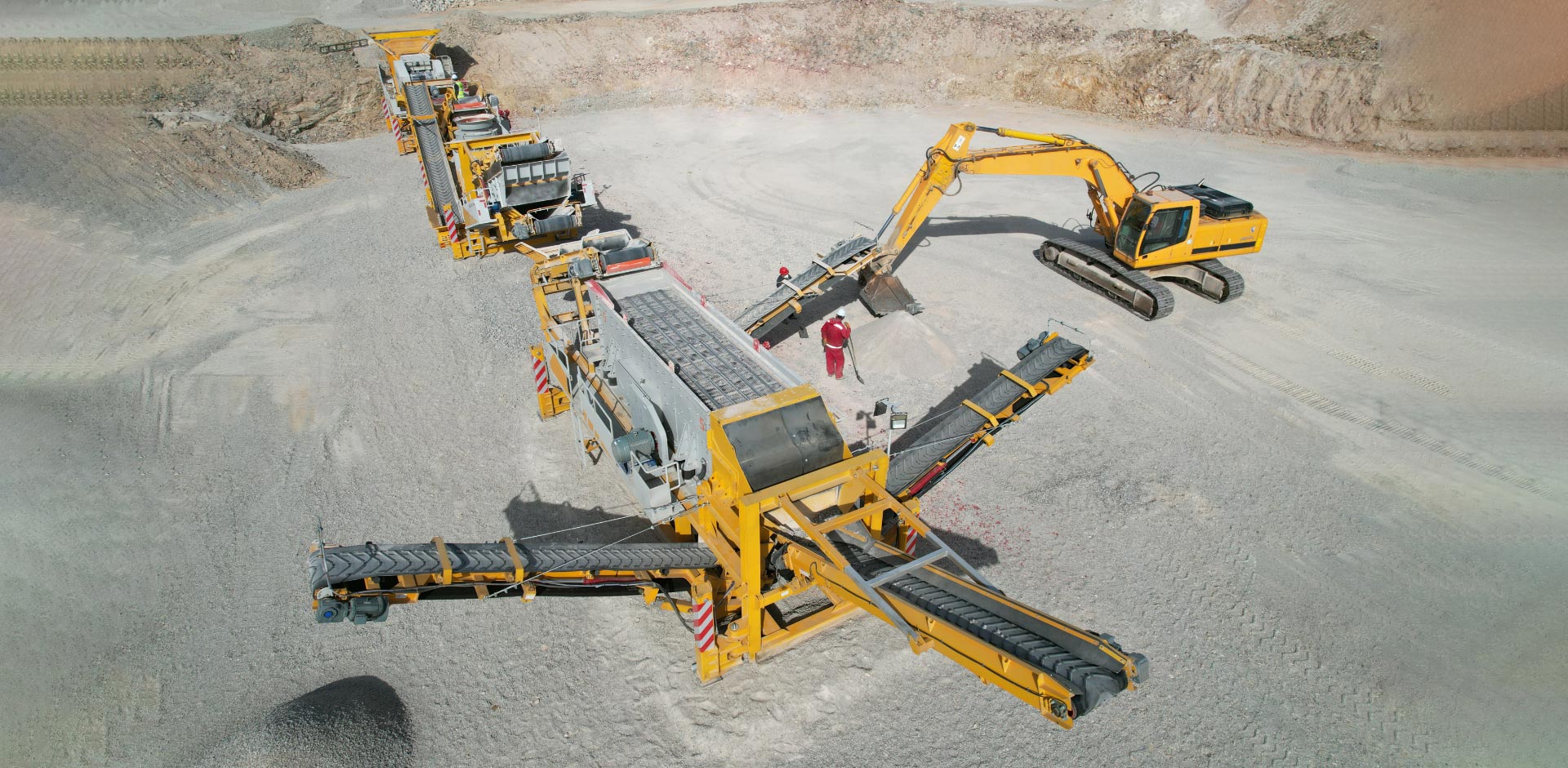
In rapidly developing metropolitan corridors, temporary infrastructure projects often require processing material directly on-site. Employing a mobile stone crusher gives operators the flexibility to set up near excavation zones and relocate easily as project phases transition. Modern mobile units feature integrated water suppression tanks, automated spray bars, and foldable dust covers. When deployed correctly, a track-mounted mobile stone crusher(trituradora de piedra móvil) minimizes the need for continuous truck transport, thereby eliminating a major source of fugitive road dust along urban haul corridors.
Comparison of Processing Units and Environmental Controls
| Equipment Type | Primary Application | Dust Generation Level | Recommended Mitigation System |
|---|---|---|---|
| Jaw Crusher(trituradora de quijada) | Primary crushing of run-of-mine rock | Moderate (Coarse dust) | High-pressure water misting at hopper and discharge chute |
| Impact Crusher | Secondary shaping and cubical aggregate production | High (Ultra-fine dust) | Full chamber enclosures, rubber curtains, and baghouse filters |
| Mobile Stone Crusher | On-site urban crushing and flexible contract processing | Moderate to High | Integrated water tanks, atomized spray bars, and canvas covers |
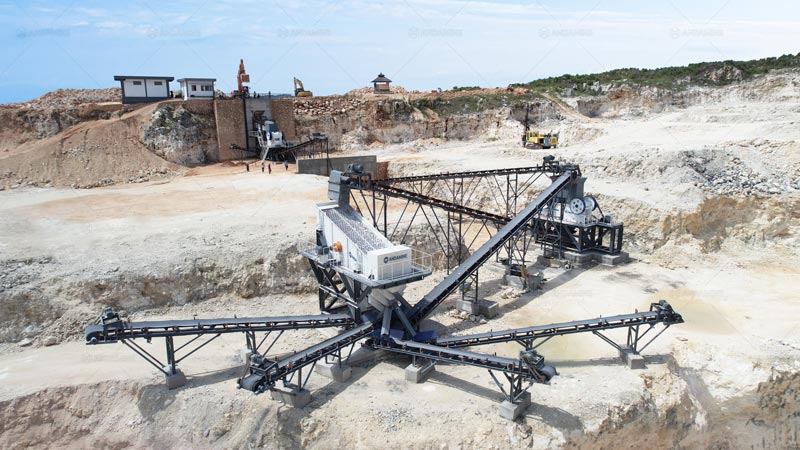
| Aggregate Plant Circuit | Full-scale multi-stage washing, screening, and stockpiling | Variable across stages | Enclosed conveyor belts, telescopic chute drop socks, and wet washing screens |
Community Compliance Guidelines for Metropolitan Depots
Technical solutions alone cannot ensure long-term operational success without a structured social compliance plan. Environmental authorities in Colombia and Brazil mandate rigorous monitoring and active community engagement for industrial sites operating near municipal zones. Aggregate producers should implement the following baseline practices:
- Real-Time Air Quality Monitoring: Install optical particle counters along the depot perimeter downwind toward residential areas to record continuous PM10 and PM2.5 readings, ensuring operational transparency.
- Vegetative and Acoustic Buffers: Plant dense evergreen tree lines and erect earthen berms along site boundaries to block dust migration and dampen operational noise.
- Haul Road Management: Pave internal access roads and mandate automatic tire-washing systems for all outbound delivery trucks to prevent tracking mud and sediment onto public city roads.
- Stockpile Management: Limit stockpile heights and install automatic chemical crusting agent sprays or wet sprinklers to stop wind erosion during dry and windy seasons in regions like Bogotá or urban São Paulo.
Establishing an open line of communication with local neighborhood councils fosters trust. Providing real-time environmental data and establishing swift grievance redress channels helps prevent costly community blockades and regulatory shutdowns.
Strategic Action Plan for Sustainable Metropolitan Mining
Transforming an urban aggregate plant into a model green mine requires continuous investment in modern equipment, intelligent process control, and environmental stewardship. By equipping every stage of reduction—from the heavy primary jaw crusher to secondary shaping in the impact crusher(chancadora de impacto)—with advanced misting and dust collection enclosures, operators can comfortably meet strict municipal emissions limits. Furthermore, deploying a versatile mobile stone crusher allows contractors to handle local urban infrastructure demands dynamically while containing environmental impact directly at the source. Implementing these dust suppression strategies protects public health, safeguards local ecosystems in Latin America’s expanding cities, and secures the long-term profitability of urban aggregate operations.