A 100 ton gantry crane requires multiple emergency safety systems to protect operators, personnel, the lifting structure, and valuable loads during heavy-duty operations. The most important systems include emergency stop buttons, overload protection, hoisting limit switches, travel limit switches, braking systems, anti-collision devices, wind-speed monitoring, and electrical fault protection. These devices address different hazards, such as excessive lifting loads, uncontrolled movement, over-travel, strong winds, and power failures.
For industrial buyers and project engineers, selecting emergency safety systems for a 100 ton gantry crane should involve more than checking whether individual devices are installed. The systems must work together, match the crane’s operating environment, and comply with applicable safety standards. Their configuration also depends on crane design, lifting height, travel distance, operating speed, and whether the crane operates indoors or outdoors.
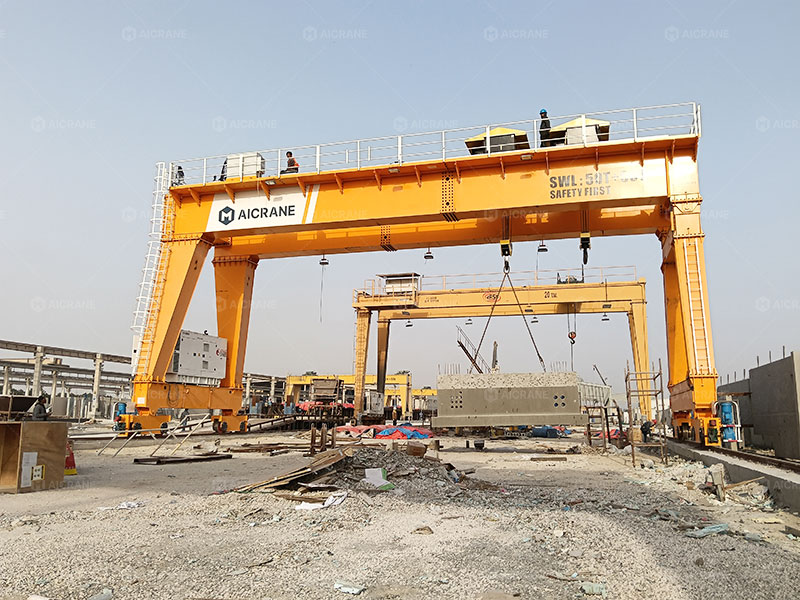
1. Why Does a 100 Ton Gantry Crane Need Emergency Safety Systems?
A 100 ton gantry crane is designed to handle extremely heavy loads in environments such as steel plants, precast concrete yards, shipyards, ports, and heavy manufacturing facilities. Its large lifting capacity creates significant safety risks if a mechanical, electrical, or control-system failure occurs.
For example, lifting a load beyond the rated capacity can overstress the main girders, trolley, hoisting mechanism, and supporting structure. If the trolley travels beyond its permitted operating range, it may collide with end stops or other equipment. Outdoor gantry cranes also face additional risks from strong winds, lightning, rain, and unstable ground conditions.
Emergency safety systems help prevent hazardous conditions, stop unsafe movements, and reduce the consequences of equipment failures.
The main safety objectives are:
-
Prevent overload: Stop or restrict lifting when the load exceeds permitted limits.
-
Prevent over-travel: Keep the trolley and crane within their designated travel ranges.
-
Control unexpected movement: Stop crane motion when an emergency occurs.
-
Protect against environmental hazards: Monitor wind conditions and activate appropriate warning or restraint measures.
-
Protect personnel: Reduce the risk of collisions, dropped loads, and unauthorized operation.
-
Support safe recovery: Allow operators and maintenance personnel to respond appropriately after an emergency stop or system fault.
Emergency protection should be designed as part of the crane’s complete safety architecture, rather than added as an isolated group of accessories.
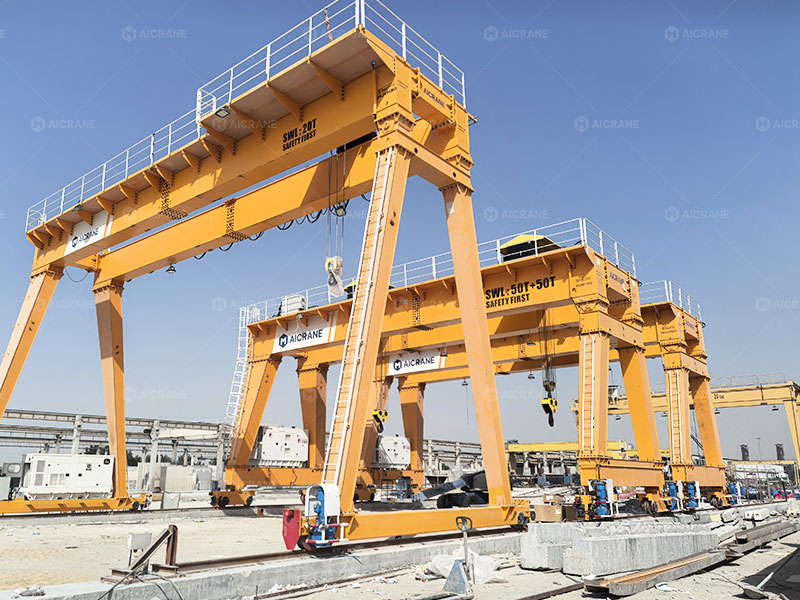
2. What Are the Essential Emergency Safety Systems for a 100 Ton Gantry Crane?
The following systems are commonly considered when specifying a heavy-duty gantry crane. Their exact configuration depends on the crane’s design, applicable regulations, and operating conditions.
2.1 Emergency Stop System
An emergency stop system allows the operator or authorized personnel to stop crane movements immediately when an unsafe condition occurs.
Typical configurations include:
-
Emergency stop buttons on the operator’s pendant control or control station.
-
Emergency stop switches in the operator’s cabin.
-
Emergency stop devices at accessible maintenance or operating positions, where required by the design.
-
A main electrical disconnect for isolating crane power.
When activated, the emergency stop circuit should interrupt the relevant motion-control functions and bring the crane to a controlled stop. The stopping behavior must account for the suspended load and the possibility that suddenly removing power could create additional hazards.
For a 100 ton gantry crane, the emergency stop system should be designed to prevent unintended restarting. After an emergency stop, the operator should identify the cause, confirm that the equipment is safe, and perform the prescribed reset procedure before resuming operation.
Selection consideration: Confirm which movements are stopped by each emergency stop device, whether the hoist brake remains engaged, and how the system responds to power interruption.
2.2 Overload Protection System
Overload protection prevents the crane from lifting loads beyond its rated capacity.
For a 100 ton gantry crane, the rated lifting capacity is generally 100 tons for the specified lifting configuration. However, the permissible load may depend on the number of hoists, lifting points, load distribution, and any special lifting arrangement.
An overload protection system typically uses a load sensor or load-measuring device to monitor the lifting force. The control system compares the measured load with the configured operating limit.
Its main functions include:
-
Monitoring the actual lifting load.
-
Displaying load information to the operator.
-
Activating an audible or visual warning when a specified threshold is reached.
-
Preventing further load-increasing hoisting when the overload threshold is exceeded, according to the approved control design.
For example, if a crane is lifting a 100 ton precast concrete component, the system should account for the actual suspended load, including applicable lifting accessories such as spreader beams and rigging equipment, when determining the load presented to the crane.
An important distinction is that overload protection does not replace correct load calculation. Operators must still verify the load weight, center of gravity, lifting points, and rigging arrangement before lifting.
Selection consideration: Ask the manufacturer about sensor accuracy, calibration procedures, overload alarm settings, load display, and the protective actions triggered by an overload condition.
2.3 Hoisting Upper and Lower Limit Switches
Hoisting limit switches prevent the hook block from traveling beyond its permitted vertical operating range.
A 100 ton gantry crane may have a considerable lifting height, particularly in precast yards, shipyards, and large industrial facilities. Without effective travel limits, excessive upward movement could cause the hook block to collide with the trolley or hoisting structure.
An upper hoisting limit switch stops upward movement when the hook approaches its maximum permitted position. A secondary or backup upper limit device may also be specified where the risk assessment and design require additional protection.
A lower limit switch can help prevent the lifting rope from being paid out beyond its permitted range, although the exact arrangement depends on the hoisting mechanism.
The upper limit switch must not be treated as a normal stopping control. Operators should stop the hook at the appropriate working position using the regular controls.
Selection consideration: Specify the maximum lifting height, hook approach distance, hoisting speed, and required limit-switch arrangement. The stopping distance must be considered when positioning the switch.
2.4 Crane and Trolley Travel Limit Switches
A gantry crane has two main horizontal movements:
-
Crane travel: Movement of the complete gantry structure along the ground rails.
-
Trolley travel: Movement of the lifting trolley along the main girder.
Travel limit switches help prevent these movements from exceeding their permitted ranges.
For a 100 ton crane, the system may include:
-
Crane long-travel limit switches.
-
Trolley cross-travel limit switches.
-
Final travel limits where required by the design.
-
Mechanical end stops.
-
Energy-absorbing bumpers or equivalent stopping arrangements.
These devices are particularly important when the crane operates close to buildings, storage areas, other cranes, or personnel access zones.
For example, in a precast concrete yard, a trolley carrying a heavy concrete component must remain within the designated lifting area. Travel limits help prevent the trolley from reaching the end of its permitted operating range.
Electrical limit switches and mechanical end stops serve different purposes. Limit switches control motion before the equipment reaches the physical end of travel, while mechanical stops provide a physical boundary and may absorb impact energy if contact occurs.
Selection consideration: The manufacturer should calculate stopping distances based on the crane’s operating speed, braking characteristics, moving mass, and site layout.
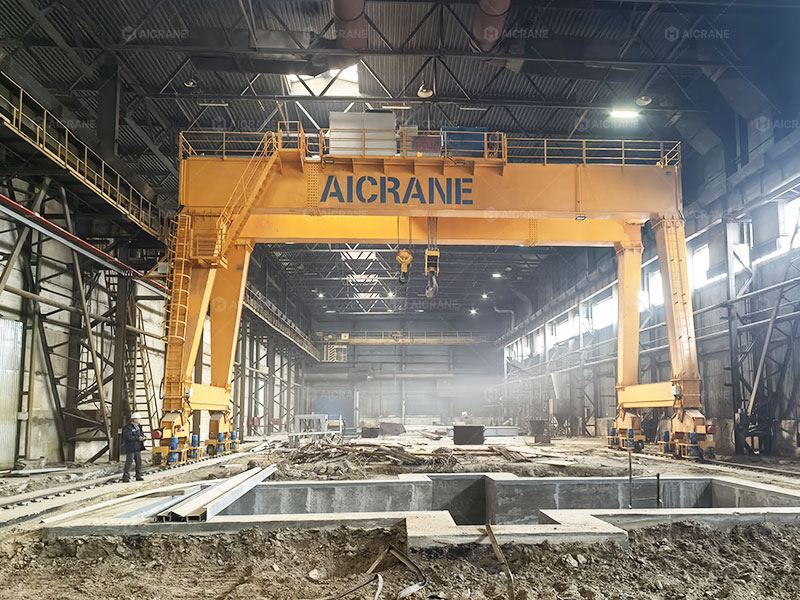
2.5 Hoisting and Travel Braking Systems
Braking systems are essential for controlling and stopping a 100 ton gantry crane.
A typical electric gantry crane uses motor-driven mechanisms with brakes designed for the relevant lifting and travel motions.
The main braking arrangements include:
Hoisting brakes: Hold the suspended load when the hoisting motor stops or power is interrupted. These brakes are particularly important because failure to hold a load can result in a serious dropped-load incident.
Trolley travel brakes: Control and stop trolley movement along the main girder.
Crane travel brakes: Control the movement of the complete gantry structure along the rails.
The braking system must be selected according to the load, operating speed, duty classification, motor characteristics, and required stopping performance.
For example, a crane handling 100 ton steel components may require different braking and control arrangements from a crane operating at lower speeds in a precast yard.
A critical design point is that the hoisting brake must be capable of safely holding the rated suspended load under the specified operating conditions. The brake should not depend solely on the operator maintaining a control command.
Selection consideration: Request information about brake type, holding capacity, brake monitoring, wear inspection, and response to power failure.
2.6 Anti-Collision Protection System
Anti-collision systems help prevent a 100 ton gantry crane from colliding with another crane, trolley, or nearby equipment.
This protection is particularly useful when two or more cranes share the same runway or operate in adjacent working zones.
Common devices include:
-
Laser distance sensors.
-
Infrared detection devices.
-
Radar-based detection systems.
-
Position monitoring and programmable control systems.
When an approaching object reaches a configured warning distance, the system can activate an audible or visual alarm. If the object enters a defined protective zone, the control system can reduce speed or stop the relevant movement.
For example, two gantry cranes working on the same runway may approach each other while transporting large steel structures. An anti-collision system can monitor their relative positions and restrict movement to reduce the risk of impact.
The protection distance should consider actual stopping distance, crane speed, load movement, sensor response time, and the possibility of sensor obstruction.
Anti-collision protection does not replace operational coordination or designated exclusion zones.
2.7 Wind-Speed Monitoring and Rail Clamps
Outdoor 100 ton gantry cranes require additional protection against wind.
Strong winds can affect the stability of the crane, increase the difficulty of controlling suspended loads, and create significant horizontal forces on the gantry structure.
A wind-speed monitoring system generally consists of an anemometer, control unit, and audible or visual alarm.
Its functions include:
-
Measuring wind speed at the crane.
-
Displaying current wind conditions.
-
Warning the operator when wind speed reaches a predetermined threshold.
-
Supporting decisions to suspend lifting or move the crane into its designated secured position.
Outdoor gantry cranes may also require rail clamps, storm brakes, or other approved anchoring devices to prevent unintended movement along the rails.
These devices are especially important when a crane is parked or exposed to severe weather.
Example: A 100 ton gantry crane operating in a coastal shipyard may face stronger and more variable winds than an indoor factory crane. Its wind-monitoring and storm-restraint configuration should therefore reflect the site’s environmental conditions and the manufacturer’s engineering calculations.
There is no single wind-speed shutdown value suitable for every 100 ton gantry crane. The operating and out-of-service wind limits must be established for the specific crane design.
2.8 Electrical Protection and Power Failure Protection
Electrical faults can cause unexpected crane movement, loss of control, or damage to motors and control equipment.
A 100 ton gantry crane should incorporate suitable electrical protection based on its power supply and control architecture.
Common protective devices include:
-
Short-circuit protection.
-
Overcurrent protection.
-
Overload protection for motors.
-
Phase-loss and phase-sequence protection, where applicable.
-
Undervoltage protection.
-
Grounding and electrical fault protection.
-
Emergency power isolation.
-
Control-system fault monitoring.
Power failure protection is particularly important for heavy lifting operations.
When the power supply is interrupted, the crane should not restart unexpectedly when electricity returns. The control system should require the appropriate reset or operator command before motion resumes.
The hoisting brake must also maintain the suspended load safely during power interruption.
For cranes using variable-frequency drives (VFDs), the manufacturer should explain how drive faults, emergency stops, and power loss affect braking and load holding.
2.9 Audible and Visual Warning Systems
Warning systems help alert operators, ground personnel, and nearby workers before or during crane movement.
Common warning devices include:
-
Electric horns.
-
Audible travel alarms.
-
Flashing warning lights.
-
Crane movement indicators.
-
Overload warning indicators.
-
Wind-speed alarms.
-
Fault and emergency status indicators.
For a 100 ton gantry crane working in a busy industrial yard, audible and visual warnings are particularly valuable when operators cannot maintain direct visual contact with all personnel in the operating area.
Warning devices should be sufficiently visible and audible for the working environment. Their locations and signaling methods should be coordinated with site traffic rules and communication procedures.
3. How Do These Safety Systems Work Together During an Emergency?
Individual safety devices address specific hazards, but effective crane protection depends on how they interact.
Consider a 100 ton gantry crane lifting a heavy steel component in an outdoor fabrication yard.
The following sequence illustrates how different systems may respond:
-
The operator begins lifting after confirming the load weight and rigging arrangement.
-
The load monitoring system detects that the lifting force is approaching the configured operating limit and activates a warning.
-
If the overload threshold is exceeded, the approved protection logic prevents further load-increasing hoisting.
-
During trolley movement, the anti-collision system detects another crane approaching and activates a warning or movement restriction.
-
If the operator identifies an immediate hazard, the emergency stop system can be activated.
-
If strong winds reach the predetermined warning threshold, the wind-monitoring system alerts the operator and the site team follows the approved weather shutdown procedure.
-
Once the crane is safely stopped, personnel identify the cause of the event before authorizing a restart.
This example demonstrates why the emergency stop, overload protection, limit switches, braking system, and environmental monitoring should be designed as a coordinated safety system.
4. How Should Buyers Select Safety Systems for a 100 Ton Gantry Crane?
The correct safety configuration depends on the crane’s technical specifications and working environment. Buyers should evaluate the following factors before finalizing the equipment configuration.
4.1 Crane Design and Lifting Configuration
First, confirm the crane’s structural and mechanical arrangement.
Important information includes:
-
Rated lifting capacity: 100 tons.
-
Single-girder or double-girder configuration.
-
Single or multiple hoisting units.
-
Maximum lifting height.
-
Main girder span.
-
Crane and trolley travel distances.
-
Hoisting and travel speeds.
-
Working duty classification.
A 100 ton double-girder gantry crane with one main hoist may require a different load-monitoring arrangement from a crane with two independent 50 ton hoists or a synchronized dual-hoist configuration.
For multiple-hoist systems, the design should consider individual hoist loads, total suspended load, load distribution, and synchronization. Monitoring only the combined load may not identify an unsafe imbalance between lifting points.
4.2 Indoor or Outdoor Operating Environment
The working environment directly affects safety-system selection.
| Operating environment | Important safety considerations |
|---|---|
| Indoor steel factory | Overload protection, hoisting limits, travel limits, braking, electrical protection |
| Outdoor precast yard | Wind monitoring, rail clamps, overload protection, travel protection |
| Shipyard or port | Wind monitoring, storm anchoring, anti-collision, outdoor electrical protection |
| Heavy manufacturing facility | Overload monitoring, coordinated lifting, warning devices, emergency stops |
| Multiple-crane runway | Anti-collision protection, travel limits, coordinated control |
Outdoor cranes generally require additional protection against wind and unintended movement. Indoor cranes may place greater emphasis on collision prevention, restricted working zones, and coordination with production equipment.
4.3 Operating Frequency and Duty Classification
A crane used for occasional heavy lifting has different operational demands from one performing frequent lifting cycles throughout multiple shifts.
The duty classification affects motor selection, brake design, electrical components, and the expected service life of mechanical systems.
Buyers should provide the manufacturer with:
-
Average lifting cycles per day.
-
Typical load weight.
-
Frequency of lifts near rated capacity.
-
Operating hours per shift.
-
Number of shifts per day.
-
Expected service life and maintenance conditions.
Safety devices must be compatible with the crane’s operating frequency and environmental conditions. A sensor or limit switch that performs adequately under occasional use may require a different specification for continuous industrial operation.
4.4 Control System and Emergency Response Logic
A safety-system quotation should describe not only the devices supplied but also their control logic.
For example, buyers should clarify:
-
Which movements stop when the emergency stop is activated?
-
Does overload protection block lifting only, or also other movements?
-
What happens when a limit switch is triggered?
-
How does the crane respond to communication loss in a remote-control system?
-
Does power restoration require a manual reset?
-
How are faults displayed and recorded?
-
Can the operator identify which safety device has been activated?
These details are important because two cranes may have similar safety-device lists but different levels of protection and control integration.
5. What Safety Standards Apply to a 100 Ton Gantry Crane?
Safety requirements depend on the country of installation, crane design, industry, and intended application. Buyers should identify the applicable regulatory framework during the engineering stage.
The following standards and regulations are useful references.
OSHA 29 CFR 1910.179 – Overhead and Gantry Cranes
This US occupational safety regulation covers overhead and gantry crane requirements, including wind indicators and rail clamps for outdoor storage bridges, hoisting overtravel limit switches, electrical disconnects, brakes, inspections, and operating practices.
ASME B30.2 – Overhead and Gantry Cranes
ASME B30.2-2022 addresses the construction, installation, operation, inspection, and maintenance of applicable top-running overhead and gantry cranes. It is an important reference for buyers and engineering teams working with relevant crane configurations in North America.
ISO 12480-1:2024 – Cranes: Safe Use, Part 1: General
This international standard provides guidance on safe crane use, covering task planning, selection, erection, dismantling, operation, maintenance, and the selection of operators, slingers, and signallers.
These references should not be treated as interchangeable. A crane project may need to comply with local legislation, applicable design standards, electrical requirements, and customer-specific specifications simultaneously.
For international projects, buyers should confirm the required standards before manufacturing begins. This helps avoid modifications to electrical systems, braking arrangements, warning devices, and documentation during final inspection.
6. How Should Emergency Safety Systems Be Tested and Maintained?
Installing safety devices is only the first step. Their reliability depends on regular inspection, functional testing, calibration, and appropriate maintenance.
A practical maintenance program for a 100 ton gantry crane should include the following activities.
Daily or Pre-Shift Checks
Operators or designated personnel should check:
-
Emergency stop buttons and accessible control devices.
-
Audible and visual warning systems.
-
Hoisting upper limit switch operation, using the prescribed safe test procedure.
-
Braking behavior and abnormal noises.
-
Load display and warning indications.
-
Visible damage to cables, sensors, and control equipment.
Periodic Inspection
Qualified maintenance personnel should inspect:
-
Load sensors and overload protection calibration.
-
Hoisting and travel limit switches.
-
Brake linings, actuators, and mechanical connections.
-
Anti-collision sensors and detection zones.
-
Wind-speed monitoring equipment.
-
Electrical cabinets, contactors, wiring, and grounding.
-
Rail clamps and anchoring devices.
-
Emergency stop circuits and reset functions.
Functional Testing
Functional testing should verify that each protective device performs its intended action.
For example:
-
An overload protection test should verify the configured warning and protective response using an approved test method.
-
A limit-switch test should confirm that the relevant motion stops before a hazardous mechanical position is reached.
-
An anti-collision test should verify detection, warning, and stopping behavior under controlled conditions.
-
A power interruption test should verify that the crane does not restart unexpectedly and that the suspended load remains safely supported.
Testing should follow the manufacturer’s procedures and applicable regulatory requirements. Tests involving suspended loads or safety-critical functions must be planned and supervised by qualified personnel.
Importantly, operators should never bypass safety devices to maintain production. If a critical protection system is defective, the crane should be removed from service until the problem is evaluated and corrected.
7. What Should Buyers Include in a 100 Ton Gantry Crane Safety Specification?
When requesting a quotation, buyers should provide enough information for the manufacturer to determine the required safety configuration.
The following checklist can be used during technical discussions.
| Item | Information to confirm |
|---|---|
| Rated capacity | 100 tons |
| Crane configuration | Single or double girder; single or multiple hoists |
| Lifting height | Required hook lifting height |
| Span | Distance between crane support legs |
| Working environment | Indoor, outdoor, coastal, or industrial |
| Hoisting protection | Overload protection and upper/lower limit arrangements |
| Travel protection | Crane and trolley travel limits |
| Emergency control | Emergency stop locations and stopping logic |
| Braking | Hoisting, trolley, and crane travel brakes |
| Collision protection | Required detection zones and other cranes or obstacles |
| Wind protection | Wind alarm and rail clamps or storm anchoring, where applicable |
| Electrical protection | Power isolation, short-circuit, overcurrent, and relevant fault protection |
| Control method | Cabin, pendant, radio remote, or combined control |
| Applicable standards | Country-specific regulations and project requirements |
| Testing documents | Inspection, functional test, and commissioning records |
Providing these details early allows the manufacturer to integrate the required protection into the crane’s mechanical, electrical, and control systems.
It is generally more practical to specify safety functions during the design stage than to retrofit them after installation.
8. Frequently Asked Questions About 100 Ton Gantry Crane Safety Systems
What is the most important safety device on a 100 ton gantry crane?
There is no single device that protects against every crane hazard. Overload protection, hoisting limit switches, emergency stops, braking systems, and travel protection address different risks. Their combined operation is essential for safe crane operation.
Does a 100 ton gantry crane need an overload protection system?
Overload protection is an important safety feature for heavy-duty lifting equipment. Its exact design, required protective functions, and compliance obligations should be established according to the applicable standards and project risk assessment. It does not replace load verification or proper lifting procedures.
What happens if a 100 ton gantry crane loses power while lifting?
The hoisting brake should engage or otherwise maintain the suspended load safely according to the crane’s fail-safe design. The control system should also prevent unexpected restarting when power returns. Operators must follow the manufacturer’s recovery procedure before resuming operation.
Are wind alarms necessary for outdoor gantry cranes?
Wind monitoring is important for outdoor gantry cranes because wind can affect crane stability and suspended-load control. OSHA 29 CFR 1910.179 specifically requires wind-indicating devices and automatic rail clamps for outdoor storage bridges covered by that provision. The precise requirements for other crane configurations depend on applicable regulations and design standards.
What is the difference between a limit switch and an emergency stop?
A limit switch automatically restricts a specific movement when equipment reaches a predefined travel position. An emergency stop is manually or automatically activated to stop hazardous crane movement independently of regular operating controls. They perform different safety functions and should not replace each other.
How often should crane safety systems be inspected?
Inspection frequency depends on the applicable regulations, manufacturer’s instructions, operating intensity, and environmental conditions. Operators should conduct prescribed pre-shift checks, while qualified personnel should perform periodic inspections, calibration, and functional testing according to the maintenance plan.
Can safety systems be added to an existing 100 ton gantry crane?
Yes, additional safety devices can often be installed on existing cranes. However, retrofitting requires an engineering assessment of the existing electrical and mechanical systems, control architecture, braking performance, and compatibility with the new devices. Any modification affecting crane safety or rated capacity should be reviewed by qualified engineers.
Conclusion: Integrating Safety into 100 Ton Gantry Crane Design
Emergency safety systems for a 100 ton gantry crane should be selected according to lifting capacity, crane configuration, operating duty, site conditions, and applicable safety standards.
The essential protection functions include emergency stops, overload protection, hoisting and travel limit switches, reliable braking, anti-collision devices, wind monitoring, and electrical fault protection. For outdoor installations, rail clamps or other suitable storm-restraint devices are also important considerations.
For industrial buyers, the key is to specify these functions as an integrated system during the initial engineering stage. A well-designed safety configuration helps control operational risks, supports reliable lifting operations, and makes inspection and maintenance more manageable throughout the crane’s service life.
When planning a 100 ton gantry crane project, work with the manufacturer to review the lifting requirements, site layout, environmental conditions, control system, and safety documentation before confirming the final technical specification.