Designing a 100-ton overhead crane involves far more complexity than general medium-duty lifting equipment. This type of crane is typically used in steel mills, heavy machinery manufacturing workshops, power plant turbine halls, metallurgical operations, and large-scale fabrication facilities. What distinguishes a 100-ton crane from lighter-duty systems is not just the lifting capacity, but the overall engineering depth required in mechanical, electrical, structural, and operational planning.
To ensure that a 100-ton crane performs safely and reliably, engineers must consider a wide range of structural loads, dynamic forces, duty classifications, operational needs, and workshop building conditions. In particular, when the crane is installed inside a steel structure workshop, the building and crane interact closely, and this relationship directly influences the crane’s capacity design and safety margin.
The following sections outline the key special considerations required when designing the lifting capacity of a 100 ton overhead crane.
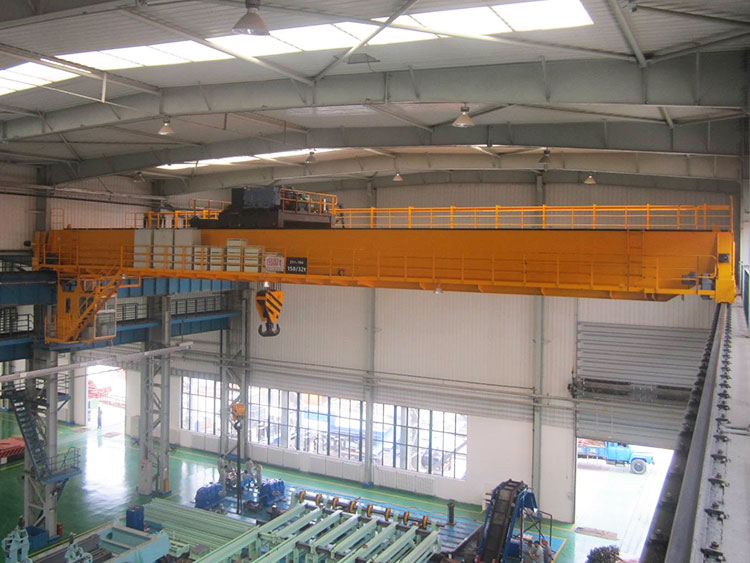
1. Increased Structural Loads and Their Influence on Crane Design
A 100-ton crane introduces extremely high loads into the system – not only the rated load itself but also the weight of the trolley, the weight of the girder structures, and the dynamic forces generated during lifting and traveling. The design must consider:
-
Wheel loads that can exceed tens of tons per wheel
-
Horizontal forces generated during trolley movement
-
Impact loads when the load is picked up or lowered
-
Dynamic amplification factors due to acceleration, braking, and sway
These forces influence the crane’s capacity design, especially in the areas of girder strength, deflection limits, end truck design, rail selection, and motor sizing.
For heavy-duty applications such as steel mill cranes, the dynamic load factor may be as high as 1.3–1.5, which must be included when calculating the true working capacity of the crane.
2. Selection of Duty Class for 100 Ton Crane Capacity Design
Duty class directly affects the structural and mechanical design of any overhead crane. A 100-ton crane is rarely operated under light-duty conditions. Most applications fall into:
-
A5–A6 for general heavy lifting and assembly
-
A7 for steel mills, melting shops, and continuous operations
A higher duty class requires:
-
Stronger beams with higher fatigue resistance
-
Larger motors and braking systems
-
Reinforced end carriages
-
Heavier-duty hoist drums and wire ropes
-
More robust wheel and rail systems
Therefore, the crane’s rated capacity is inseparable from the operational frequency and intensity of the application.
3. Girder Design Considerations for 100 Ton Cranes
A 100-ton overhead crane almost always adopts a double-girder box structure due to the following advantages:
-
Higher load-bearing capability
-
Better torsional resistance
-
Lower deflection
-
Ability to support large trolley and hoist systems
Engineers must carefully design the girder cross-section to handle:
-
Vertical bending from the lifted load
-
Lateral forces during trolley travel
-
Torsion produced by off-center lifting
-
Fatigue stress at weld joints
In addition, the deflection limit for heavy-duty double girder cranes is typically more stringent. Common criteria include:
-
Vertical deflection ≤ L/800 – L/1000
-
Lateral deflection meeting strict serviceability standards
Excessive deflection would not only reduce crane performance but also affect workshop operation, especially for high-precision manufacturing environments.
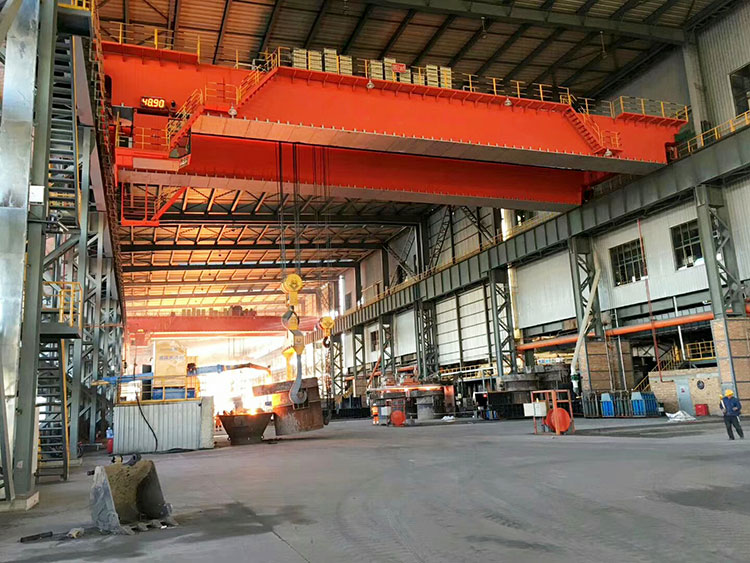
4. Trolley and Hoist Capacity Design Requirements
A 100-ton main hoist involves a complex mechanical system with:
-
Large-diameter rope drums
-
Multi-layer winding
-
Multiple falls of wire rope
-
High-power motors
-
Heavy-duty brakes
-
Oversized hook blocks
Special considerations include:
4.1. Rope strength and reeving system design
Wire ropes must be selected according to:
-
Breaking force
-
Safety factor
-
Fatigue resistance
-
Working environment (heat, dust, corrosion)
High-temperature environments, such as steel mills, may require heat-resistant wire ropes and special lubrication.
4.2. Hoist motor sizing
Motors must handle not only the rated load but also acceleration torque and overload peaks. Variable frequency drives (VFD) are commonly used to:
-
Reduce swing
-
Improve positioning accuracy
-
Protect mechanical components
4.3. Brake design
For a 100-ton load, dual braking systems are often required to meet safety standards.
5. Impact of the Steel Structure Workshop on Crane Capacity Design
The steel structure workshop plays a critical role in determining the crane’s capacity characteristics. When installing a 100-ton crane, the workshop design must consider:
5.1. Runway beam strength
Runway beams must withstand extremely high vertical loads from crane wheels. This requires:
-
Large cross-section beams
-
Reinforced web plates
-
Stiffeners at wheel load zones
-
High-strength anchor bolts or welded connections
5.2. Crane runway columns
Columns supporting a 100-ton crane must have:
-
Sufficient axial load-bearing capacity
-
Adequate resistance to horizontal forces
-
Proper lateral bracing to prevent sway
When crane loads change direction quickly, these horizontal forces become especially significant.
5.3. Crane rail selection and installation
Rails must resist wear, deformation, and lateral stress. Common selections include QU70, QU80, or even heavier rails depending on wheel load.
5.4. Building vibration and stiffness
A building supporting a heavy-duty crane must ensure:
-
Minimal vibration during crane travel
-
Enough stiffness to maintain alignment
-
Strong inter-column bracing and roof bracing
Crane-induced vibration can influence production equipment, worker comfort, and long-term structural stability if not controlled.
6. Safety Margins and Overload Protection
A 100-ton crane requires multiple safety mechanisms:
-
Overload limiters
-
Load weighing systems
-
Anti-sway controls
-
Emergency brakes
-
Buffer systems
-
Travel limit switches
The capacity design must ensure that the crane cannot operate beyond its maximum safe load.
7. Environmental and Operational Factors
Environmental conditions significantly influence capacity design:
-
High temperatures (steel mills)
-
Dust and particles (cement plants)
-
Corrosive atmospheres (chemical plants)
-
Heavy usage cycles (fabrication workshops)
These factors dictate material selection, protection levels, motor types, and structural reinforcement.
Conclusion
Designing the capacity of a 100-ton overhead crane is a comprehensive engineering process that requires careful attention to structural loads, girder strength, hoist configuration, safety systems, and long-term durability. When such a crane is installed inside a steel structure workshop, the building’s columns, runway beams, bracing system, and rail installation become key elements that directly influence the crane’s performance and safety.
Only with a coordinated approach integrating crane engineering and workshop structural design can a 100-ton crane operate safely, efficiently, and reliably in high-demand industrial environments.